

The bond market has been in a multi-day spasm, and the prevailing commentary over deficits, inflation five years behind target, Fed uncertainty, and geopolitical tail risk is almost entirely composed of facts the market has known for months if not years.
None of it constitutes new information, and price moves require marginal information, not restated priors.
If the market were pricing on consensus knowledge of the fiscal trajectory, the move would have been continuous rather than a “spasm” concentrated in a specific window.
Thus, the appropriate framework is not in rehashing old stories, but in seeking out what changed, when, and then triangulate our way to the why.
The mechanism generating higher long yields inverted on July 27, shifting from a real-neutral-rate story (constructive, capex-driven) to a term-premium story (less constructive, compensation for risk) within a five-trading-day window.
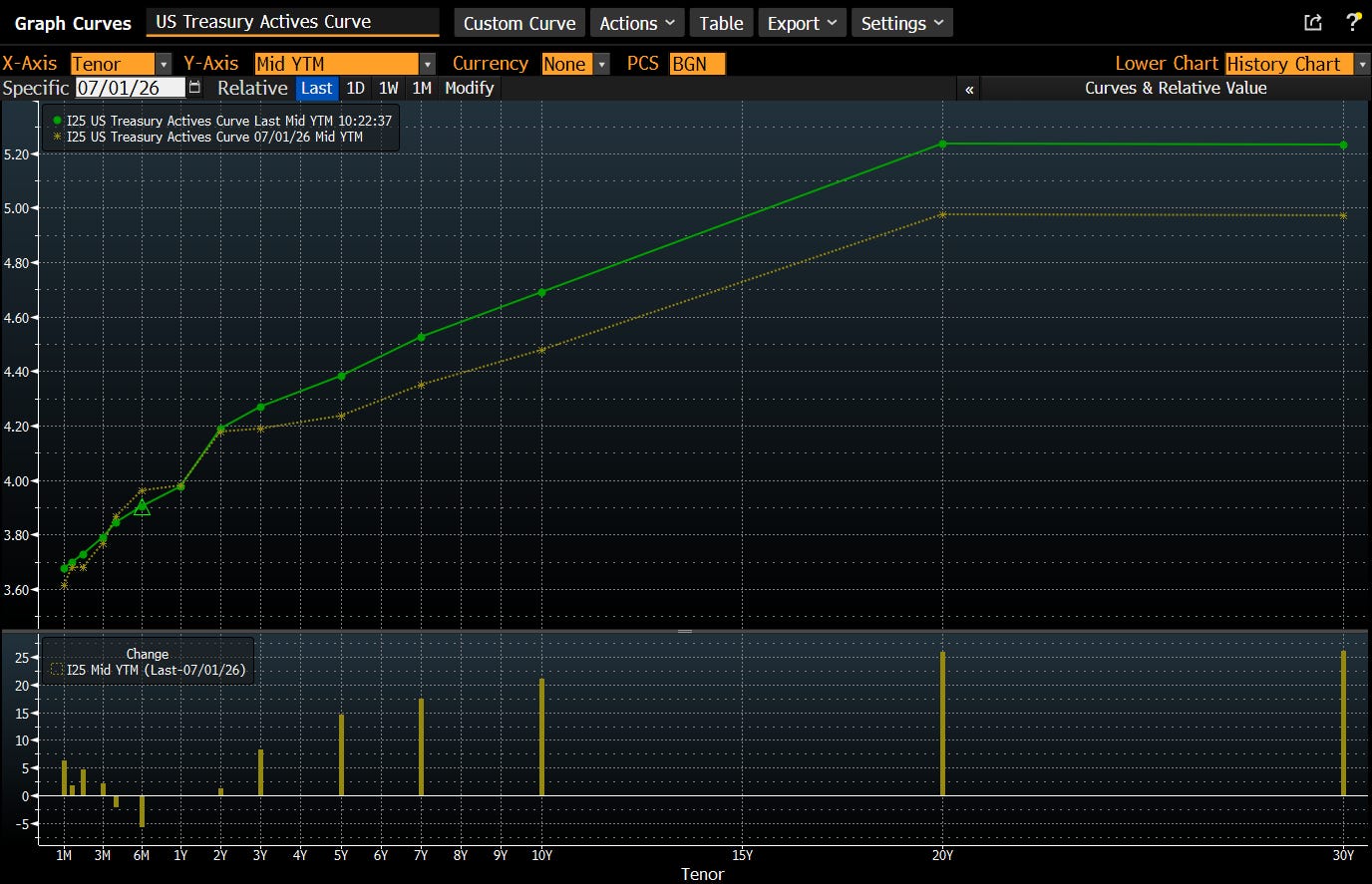
From July 1 through August 20 (latest available):
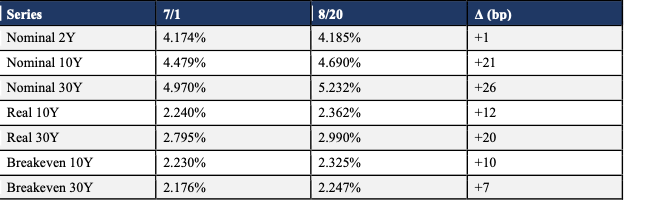
The front end is flat while the belly and long end are both up. The shape of a curve has steepened, not parallel shifted.
The relative size of the 10Y and 30Y moves is not in itself evidence of anything: a longer-duration instrument moving more basis points than a shorter one is simply DV01 delta (the notional dollar value change for every corresponding 1-basis point change in rates), and is not a signal.
A genuine Fed-repricing event would also show up at the front end, and it has not.
Measured against their own historical distributions, the 10-year is not stretched, but the 30-year is.