Introduction
In the namesake film, John Wick is nicknamed “Baba Yaga”, which the film translates to “boogeyman” from Russian.
The film got the translation wrong.
In Russian folklore, Baba Yaga is not the boogeyman. Baba Yaga is in fact an eccentric forest witch who lives in a hut.
The real mythical night thief of bad children is Babay, which loosely sounds like baby in English and is not as frightening of a depiction of our professional assassin hero.
These pages will take artistic liberty and correct the film’s linguistic mistake by sub-titling this note Бугимен, which is the Russian word for boogeyman (bugimen).
The inflation picture emerging from this week’s release of PPI and CPI is not the financial market boogeyman.
The financial boogeyman is whether we are looking into the abyss of a regime shift or simple reversion to the mean in rates markets, and by extension, a continuation of the rally in risk assets despite the summer stall.
Executive Summary
Rates: Nominal 10’s are 2bps shy of their October 2023 peak, while real 10’s crossed that line on September 10th.
The real question isn’t the level, it’s the regime. A cross-history look at 10-year yields versus nominal GDP growth shows three regimes. The current reading is uninformative and useless because it’s consistent with either a continuation of the last 25 years’ anchored regime or the early stage of a shift toward a higher one. A FOMC voter has framed the Fed’s next decision as a bet between those same two worlds.
The hike is no longer the question, with the path and destination becoming the central risks. Since the Fed-Funds rate became the Fed’s primary tool in the 1990s, there has been exactly only one one-and-done hiking cycle. Thus, markets repriced from roughly two cumulative hikes through next June to at least three this week alone. The open questions are how many, whether the Fed needs to actively lean against nominal GDP, and whether hikes even reach the part of the economy driving the overshoot.
Driver: the move since July 27–28 is real-yield-led. A longer-horizon replication of the same decomposition back to March 2022 finds an even larger term-premium share (65%), and real yields have now caught up to trend real GDP growth for the first time since the 1990s.
Peak inflation hysteria confirmed: the core CPI/PCE wedge is the widest since the early 1980s in a series going back to 1960. Strip out the stock-market-driven portion of the gap (portfolio services) and a real, AI/software-driven wedge remains.
Equities rotated again. The healthcare/financials decoupling and the semiconductor/momentum pullback both peaked in the August 19 - 27 window and have unwound in lockstep since. These two independent dispersion trades are consistent with a single macro factor reasserting itself.
Positioning: Pinebrook’s own closing of semi/momentum shorts and adding duration are both consistent with the data, but the duration trade is a bet that we remain in the anchored regime described above, En-Shala.
I. The Rates Regime: Fall 2023, Revisited
Rates, both nominal and real, are being described everywhere (including here!) as “back to levels last seen in fall 2023.”
Using the actual October 2023 cycle highs as the reference point rather than a vibe, three of these four series are just restating old news.
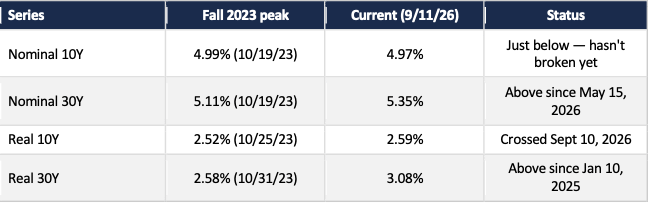
Source: US Treasury real-yield series and Bloomberg (USGGT10Y, USGGT30Y, USGG10YR, USGG30YR).
Real 30Y has been above its fall-2023 high for twenty months.
The only series both elevated and freshly notable is real 10Y, which crossed its own fall-2023 peak on September 10th.
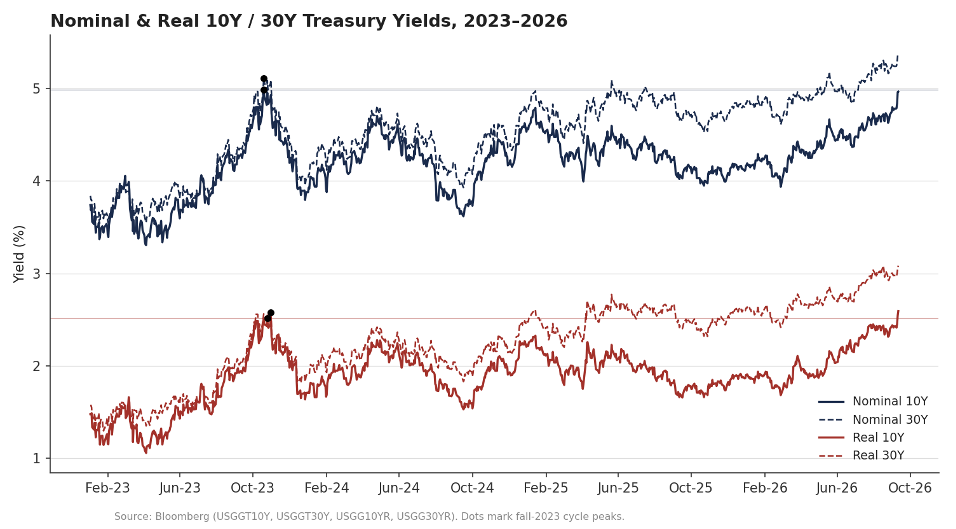
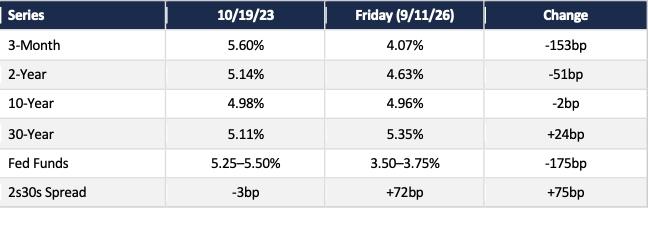
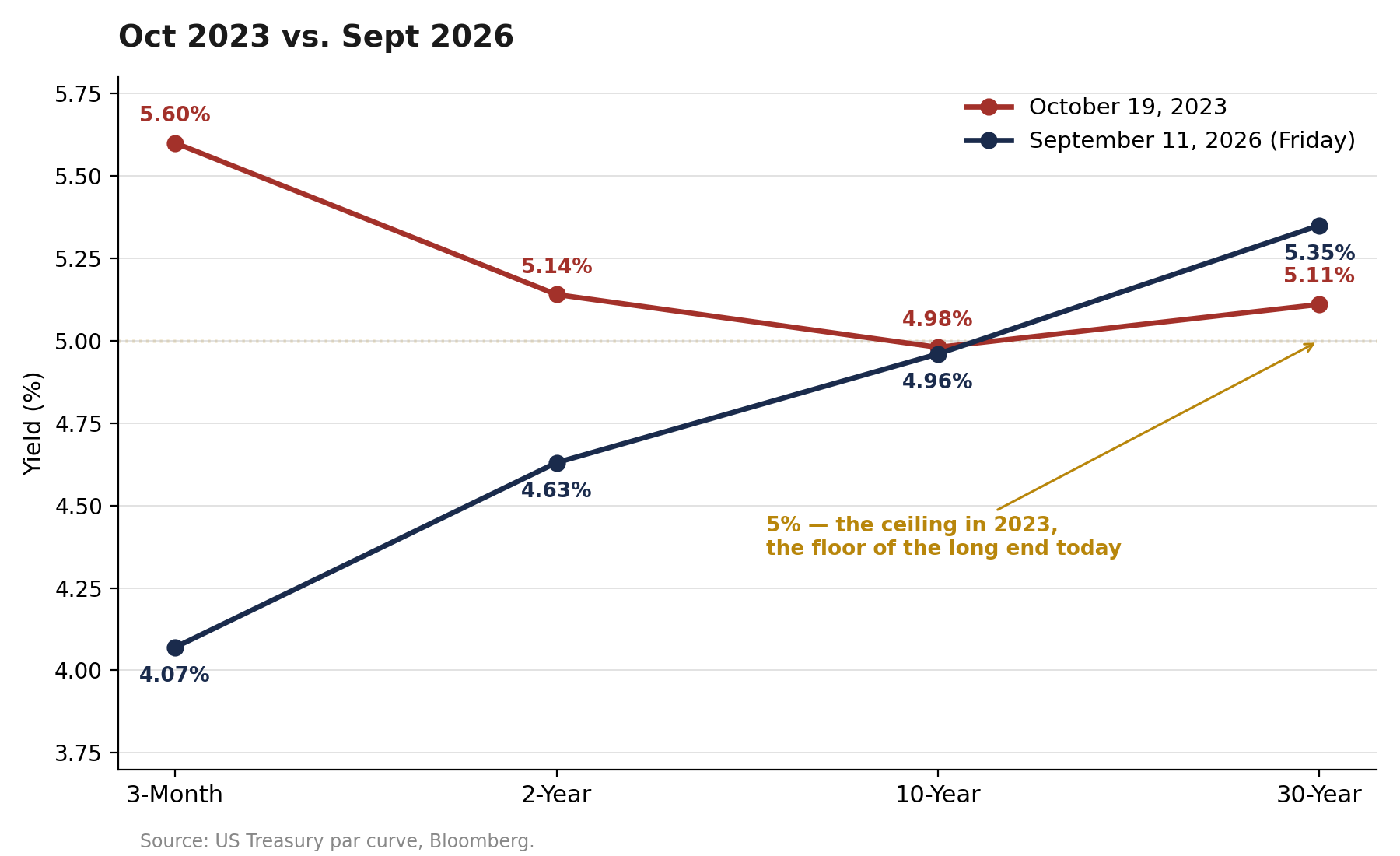
The level comparison understates how different this moment is from October 2023, because the shape of the curve is different.
Source: US Treasury real-yield series and Bloomberg
In October 2023 the curve was inverted. Today 5% is the floor of the very long end, with a positively sloped curve underneath it.
That change in shape, not just the coincidence of a shared 10Y print, is what makes the 2023–2024 playbook hard to run with.
What pulled the 10Y down from 4.98% back then was the policy rate coming down with inflation.
The current policy rate is already 175bp lower than it was that day, and the 3-month has followed it down 153bp, but the 2Y has only given back 51bp, and the 30Y is higher than its 2023 peak.
July 28 & Jackson Hole
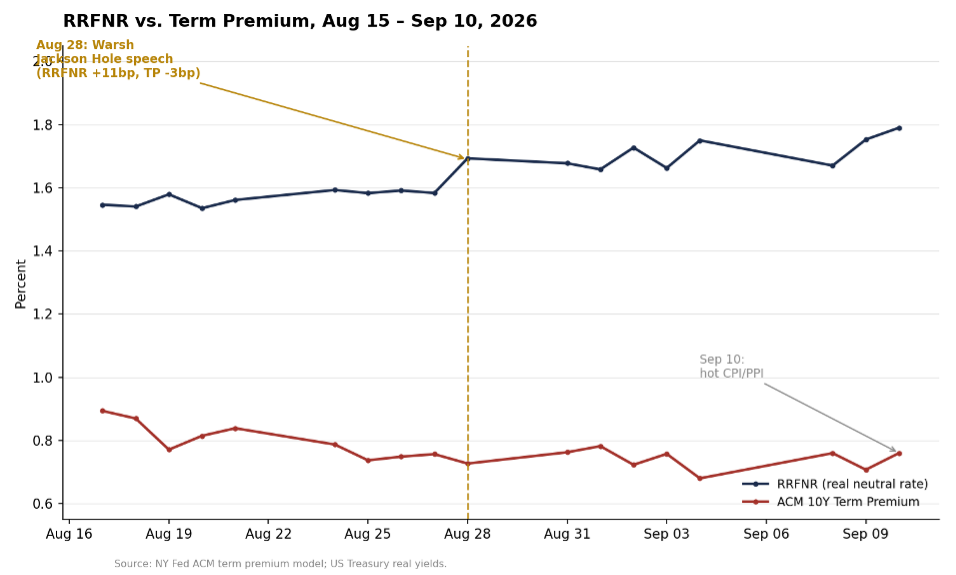
These pages dated a rates shift on July 27 - 28, when the factor generating higher long yields changed from a term-premium story to a real-neutral-rate. Six weeks on:
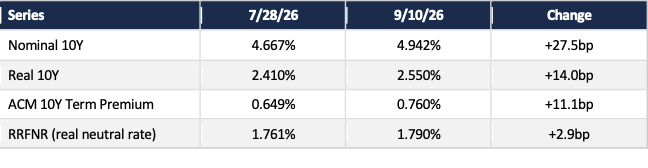
Chair Warsh’s Jackson Hole keynote produced the single largest daily RRFNR move of the window at +11bp, with term premium falling 3bp the same day.
Warsh explicitly disavows forward guidance (a “hall-of-mirrors problem”), which should raise uncertainty compensation.
Instead, the market traded his other message: business capex running near 9% y/y, the fastest since 2021, more than half attributable to AI, alongside inflation he called “not self-executing.”
The bond market read the growth case as credible and repriced RRFNR upward. Days later NY Fed President Williams attributed rising yields directly to AI and data-center investment, and by rate-sensitive equity sectors (Real Estate, Utilities) selling off right after the speech.