

The last edition of this series, back on December 18, 2025, concerned itself with finding a signal amid the economic data slop that was a result of last quarter’s government shutdown.
The core message then was that the labor market had not reached a tipping point that would motivate the FOMC to cut interest rates in January.
This posture was validated by this month’s release of the December U3 employment rate, which improved modestly from 4.5% to 4.4%, and has sealed the deal on a pass on cutting.
While obviously not the sole causal driver, the U.S. 10-year note has responded as expected with the evolution of the published data (labor, growth, earnings, etc.), moving from 4.12% on December 18th to 4.22% by close of January 17th.
[For purposes of this discussion, Monday’s treasury market price action is not considered as the signal value is lost to geopolitical noise regarding Greenland].
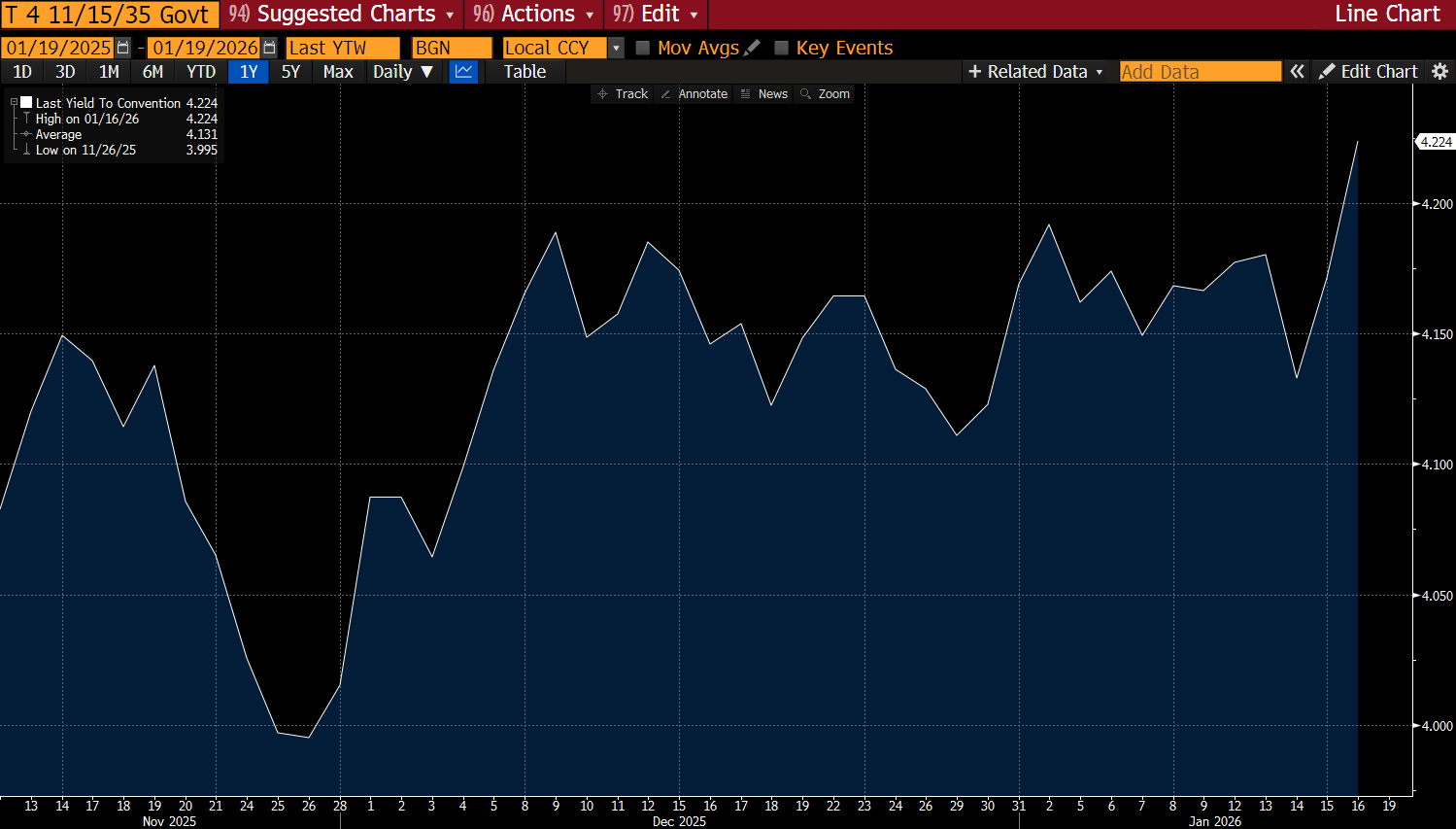
Pinebrook’s modal expectation is for U.S. rates to continue their upward trajectory, but not for the reasons most would suspect, which include:
The U.S. fiscal position.
An expected wholesale dumping of U.S. debt obligations by foreign central banks.
A repudiation of Trumponomics.
An incoherent foreign policy approach by Donald Trump.
The search for a new Fed Chair.
The above is the noise.
Similar to how evolutions in the labor market, which was impacted by immigration (first by President Biden and then by President Trump), provided the signal, the labor market is once again the signal source for Pinebrook’s forward view of the economy.
Similar to how the above immigration-driven population adjustments impacted the size of the labor market, and generated Sahm-Rule false positives and the paradox of stable to improving unemployment rates with collapsing non-farm payroll prints, the labor market is once again generating noise, that when filtered, generates a signal.
As always, context is everything. And in this case, context is shaped by the causal driver of the rising unemployment rate from 4% in January 2025 to a peak of 4.5% in November of 2025, and by 100-basis points from the cyclical low of 3.5% in July of 2025 to the current 4.4%
The headline unemployment rate is a ratio; a fraction. And when you look at the components of that fraction, the weak labor narrative falls apart.
We are seeing a participation boom that defies demographics.
Labor Force Participation (LFP) is up 1.5% to 2% in the age 30-64 cohort.
That is, more people in the 30–64 age bracket are entering the labor market to look for work.
In a standard recession, participation rates usually fall as workers become discouraged; now, they have risen by 1.5% to 2%.
Prime Age Employment: For the 35-64 cohort, the employment-to-population ratio is actually higher today than it was when unemployment was at its lows.
In a scenario of real labor market weakness, participation collapses because people give up. Today, people are flooding back in.
The entire 1% rise in unemployment is effectively concentrated in one demographic: the youth (Ages 16-29).
If you are under 30, this feels like a recession.
Your employment rates are tracking 2008 or 2001. Maybe it’s AI displacement, maybe it’s a skills mismatch, or maybe it’s just Last-In-First-Out dynamics.
But if you are Prime Age (35-64)? You are golden. You are working more, participating more, and earning more.
That isn’t a sign of a dying cycle; it’s a sign of a labor market that is still clearing, just at a higher volume. Thus, the pain in this labor market isn’t broad-based; it is surgically precise.
Just as the consumer is profiled by a K-shaped curve, so too is the labor market.
Just as the consensus conflates a pullback in spending at the bottom with a pullback in aggregate spending, so too does the consensus conflate weak youth employment with weak aggregate employment.
The two things, however, are not the same. Thus, U3 is the noise. Prime Age Employment is the signal.
The consensus is still too bearish on growth. The US consumer - specifically the one with a job, a mortgage and the 401k - is still in the game to spend and drive aggregate demand even hotter.
A labor market that is, in the aggregate, running hotter than expected has implications beyond maintaining aggregate demand.
First and foremost, the pause in the interest rate policy cutting cycle gets extended even more, validating the pause extension call made on November 25, 2025.
The rates complex will continue to face upward pressure.
With the Fed pausing (keeping nominal rates high) and inflation potentially moderating or sticky, real rates will remain elevated.
The US is the only major bloc generating endogenous growth via this labor supply shock.
Higher short rates will pressure the U.S. dollar up relative to other FX pairs, all else being equal. With the Fed pausing and the ECB/BoE potentially forced to cut sooner due to weaker growth, the spread widens in favor of the Dollar.
If wages stay sticky due to high participation and churn, services inflation will require a longer time frame to normalize.
If the US labor market is strong, global demand isn’t collapsing.
EM countries that export what the world needs - and run trade surpluses - can weather the USD storm.
Concluding Remarks
Surface level metrics, such as U3 or NFP, are suggesting a softening labor market.
The boom in labor force participation rates across the non-young cohorts argues for expanding labor market strength, in the aggregate.
The U.S. equity rotation that was flagged in November and December 2025 will continue to broaden.
The U.S. labor market will also continue to fuel global demand, which will benefit twin-surplus account non-U.S. countries.
Hi David, first off - great post!
Curious how you see politics fitting into all of this, especially if Trump finds a subservient Fed chair to cut rates into midterms? It seems a real possibility to my mind..
This piece is excellent—it cuts through the noise and focuses on the employment rate of the prime-age population.