


The two notes that preceded this one, the October 7th Signal & Noise Filter and the October 13th Market Commentary, pointed towards cyclical bullishness balanced on a narrow set of conditions, mainly that the AI secular trade stays on track.
Last week the S&P 500 fell 2.0%, the Nasdaq 4.5%, and SMH 10.5%, the worst week for chips since April 2025.
Thus, “we are so back” has given way to “it is so over”.
I. What Happened
Korean memory broke first. SK Hynix fell 10.1% and Samsung 7.4% on October 13th, Korean time, before the US open and before CoreWeave. By Friday, Hynix was down 28% since September 30th and 57% from its June 22nd peak.
Then AI credit cracked. On October 14th CoreWeave’s 9⅝% 2032 bonds hit 77.8, down from 100.9 in June, and the stock fell 16%. A Gartner estimate that data-center owners need $8.5 trillion of revenue through 2030 against $3.6 trillion forecast landed the same day. Oracle’s 5-year CDS ended the week at 300bp, within about 30bp of the whole high-yield index, for a BBB- hyperscaler.
Inflation came in hot, and yields fell anyway. Core CPI rose 0.3% and core PPI 0.5%. The 10-year still fell to 5.09%. The bond market traded growth, not inflation.
Oil kept going. December Brent made a new high at $109.86 on Friday and WTI closed the week back above $100, the same week a cargo ship hit a mine and sank in the Strait of Hormuz.
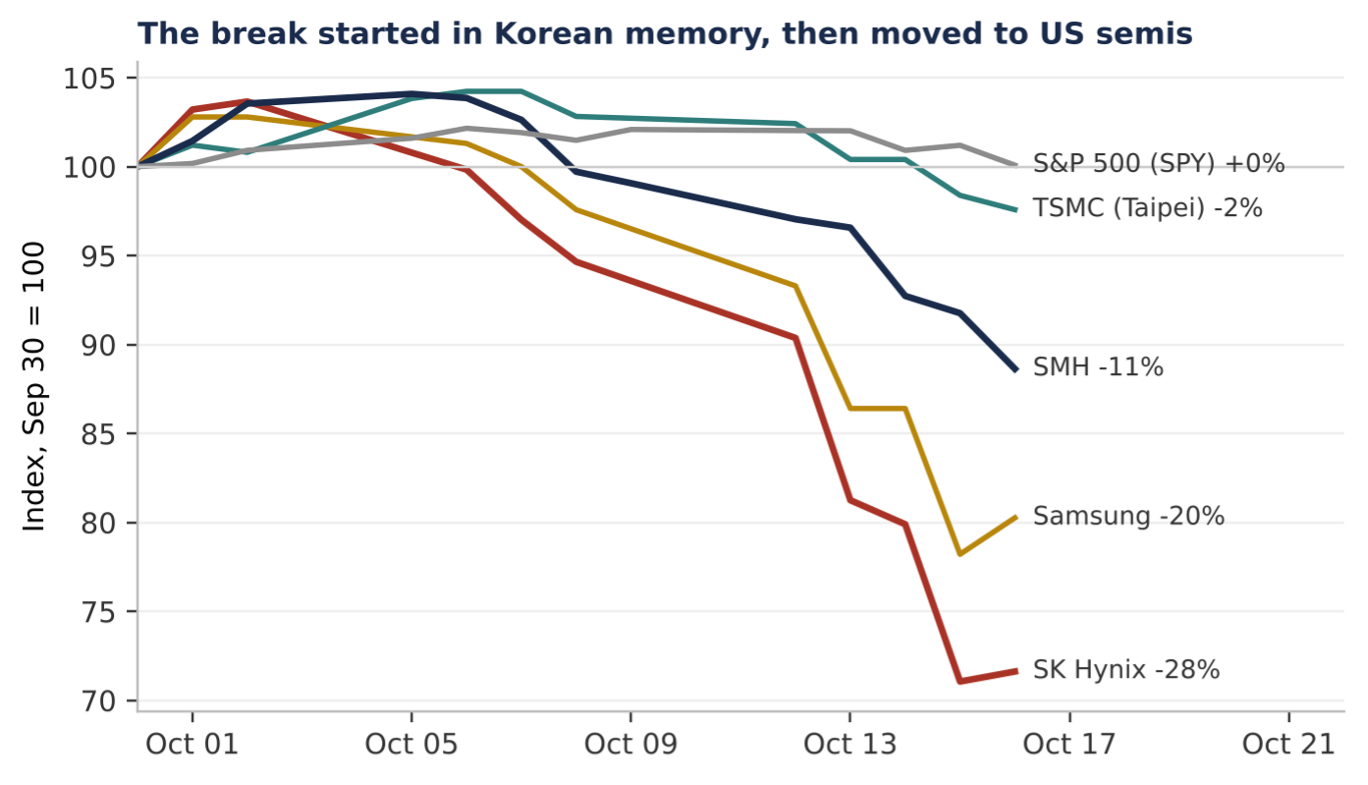
Figure 1. Bloomberg (000660 KS, 005930 KS, 2330 TT, local currency, local dates) and Pinebrook dashboard (SMH, SPY), Sep 30 = 100, through Oct 16, 2026.
II. What the Roadmap Said
The AI Test Is about Growth Rates and whether AI capex spending keeps accelerating. An AI capex wobble was flagged as problematic.
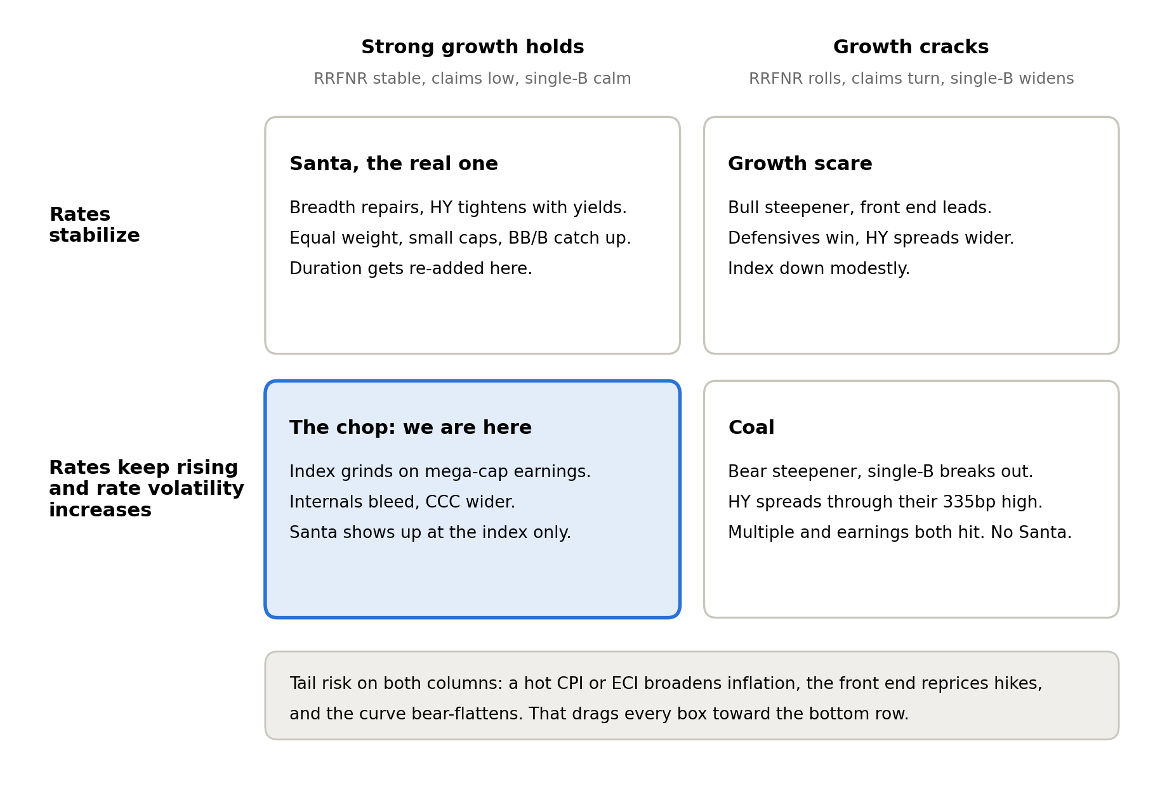
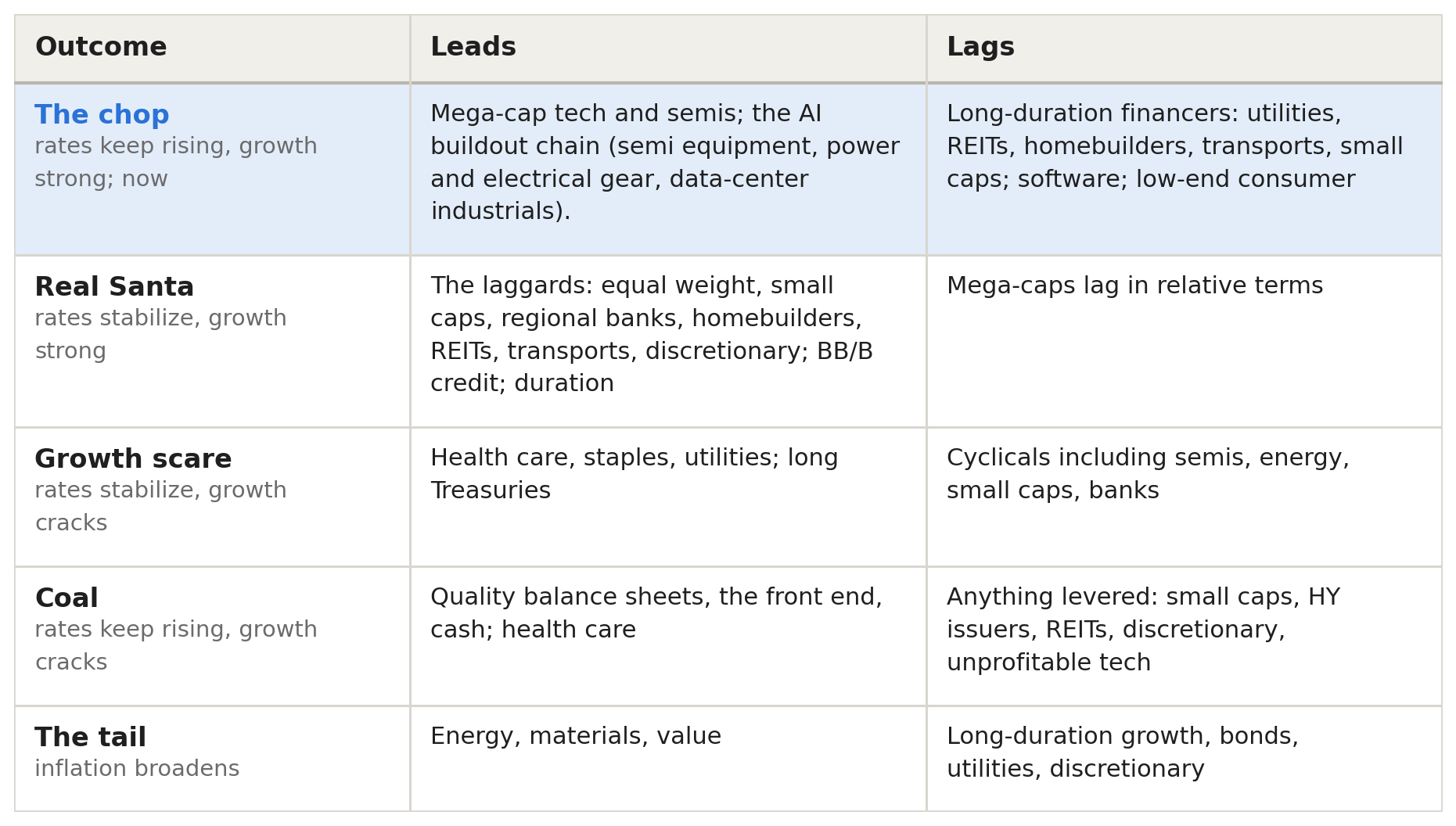
Financing was on the table. The October 13th note’s bull/bear table listed financing as one of the AI trade’s three pillars. Thus, OpenAI’s run-rate near $50 billion against $70 billion signaled, and AI debt issuance down from $113 billion in June to $23 billion in September are now flashing yellow lights.

The growth-scare row described most of last week. The October 7th outcome table: health care and long Treasuries lead; semis and small caps lag. Not in the bingo card was energy rallying instead of lagging.
The rates reaction was called in real time. In the subscriber chat before the AI numbers came out: if the one thing driving the economy sputters, 10-year yields fall. They did, through two hot inflation prints.
The inflation call held. The preview had core CPI at .26% against a .2% consensus; it printed .3%. Core PCE is now tracking .34% against a street .32%.
The XLE short was covered at Tuesday’s close. Brent has made a new high since.
III. What I Got Wrong
The positioning table mapped the wrong shock. It ran CPI outcomes through rates and sectors. Instead, the shock came through AI credit. Hot inflation with falling yields was not an expectation that made the short list.
Junk was read as a rates story. The October 7th note said CCC widening was a discount-rate shock, not a growth warning. CCC has widened another 84bp since, and single-B has followed it up.